Best Facial Sunscreen for Sensitive Mature Skin SPF 30: Top 5 Picks for 2026
 Diana Sterling comparison
 At a Glance
Discover the best facial sunscreen for sensitive mature skin SPF 30. Honest reviews, ingredient breakdowns, and price-per-use data for women 50+.
Products in This Article
This post contains affiliate links. If you purchase through our links, we may earn a small commission at no extra cost to you.
Your skin has decades of experience — and it deserves sun protection that respects that. Finding the best facial sunscreen for sensitive mature skin SPF 30 isn’t about chasing trends; it’s about protecting your investment in healthy, resilient skin without triggering redness, breakouts, or that dreaded white cast.
Why Sensitive Mature Skin Needs Special Sun Protection
After 50, your skin undergoes measurable structural changes. Estrogen decline reduces collagen production by roughly 30% in the first five years of menopause (Journal of Investigative Dermatology). The lipid barrier thins, making skin more reactive to chemical filters, fragrances, and alcohol. UV damage compounds every year it goes unaddressed — accelerating fine lines, uneven tone, and loss of elasticity.
Standard drugstore sunscreens are often formulated for younger, oilier skin. They lean on chemical UV filters like oxybenzone and avobenzone, which penetrate the skin barrier and are a known irritant trigger for sensitive types. They’re frequently loaded with fragrance. Neither is acceptable for aging sensitive skin.
What you need instead:
- Broad-spectrum protection — blocks both UVA (aging rays) and UVB (burning rays)
- SPF 30 minimum — blocks ~97% of UVB rays; the AAD recommends SPF 30 as the daily baseline
- Gentle, skin-compatible ingredients — ceramides, hyaluronic acid, niacinamide
- No fragrance, no oxybenzone — the two most common irritants in facial sunscreen
- A formula that layers well — under makeup or alone, without pilling or greasiness
Top 5 Facial Sunscreens for Sensitive Mature Skin (SPF 30)
Here’s how the five contenders compare at a glance:
| Product | SPF | Rating | Reviews | Price | Price/oz |
|---|---|---|---|---|---|
| Neutrogena Ultra Gentle + CICA | 30 | 4.3/5 | 829 | $9.97 | $2.93 |
| CeraVe Ultra-Light Lotion SPF 30 | 30 | 4.7/5 | 16,300 | $15.99 | $9.41 |
| Neutrogena Clear Face SPF 50 | 50 | 4.6/5 | 9,100 | $12.48 | $4.16 |
| CeraVe Invisible Mineral SPF 50 | 50 | 4.4/5 | 871 | $13.97 | $8.62 |
| CeraVe AM Facial Lotion SPF 50 | 50 | 4.6/5 | 4,100 | $15.87 | $5.29 |
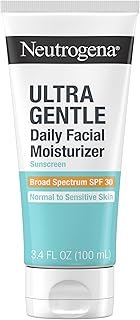
Neutrogena Ultra Gentle Daily Facial Moisturizer with SPF 30
Verdict: Best budget-friendly option for reactive skin — CICA is a genuine differentiator at this price point.
At $9.97 for 3.4 oz ($2.93/oz), this is the most affordable pick on the list. The standout ingredient is CICA (Centella Asiatica extract), a clinically studied skin-soother that reduces redness and supports barrier repair — exactly what mature sensitive skin needs. It’s fragrance-free, lightweight, and uses chemical UV filters (homosalate, octisalate, avobenzone). That last point is worth noting: if you’re highly reactive to chemical filters, look at the mineral options below. For most sensitive-but-not-severely-reactive skin types, this performs well daily.
Price-per-use (assuming 1/4 tsp daily): approximately $0.04/day.
| Pros | Cons |
|---|---|
| Lowest price per ounce on the list | Chemical UV filters (not mineral) |
| CICA soothes reactive skin | Smaller review base (829) |
| Fragrance-free | SPF 30 only — not ideal for high sun exposure |
| Moisturizer + SPF in one step |
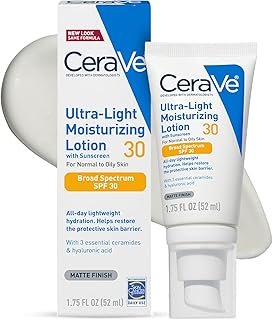
CeraVe Ultra-Light Moisturizing Lotion with SPF 30
Verdict: The most validated choice on this list — 16,300 reviews don’t lie. This is the gentle sunscreen for mature sensitive skin that consistently delivers.
A 4.7/5 rating across 16,300 reviews is statistically significant. This isn’t a product with a few enthusiastic fans; it’s a broad consensus. The formula includes hyaluronic acid (three molecular weights for layered hydration), ceramides 1, 3, and 6-II (which restore the lipid barrier that thins with age), and delivers a matte finish — a genuine benefit if you wear foundation. It’s oil-free, fragrance-free, and non-comedogenic. Chemical UV filters are used here too (octinoxate, homosalate, octocrylene), so those with chemical filter sensitivity should note that.
Price-per-use: approximately $0.10/day.
| Pros | Cons |
|---|---|
| Highest-rated product on this list (4.7/5) | Smallest bottle (1.7 oz) |
| Ceramides + hyaluronic acid support barrier health | Chemical UV filters |
| Matte finish — layers under makeup | Higher cost per ounce |
| Fragrance-free, oil-free |
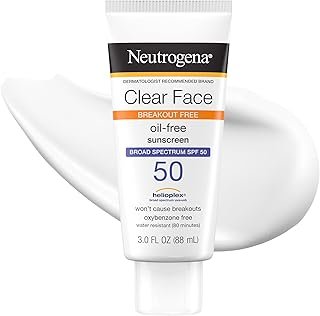
Neutrogena Clear Face Sunscreen Lotion SPF 50
Verdict: Best for women who want higher SPF protection without oxybenzone — a meaningful formulation choice.
While labeled for acne-prone skin, this anti-aging sunscreen for sensitive skin earns its place here for one key reason: it’s oxybenzone-free. Oxybenzone is a chemical filter flagged by dermatologists as a common sensitizer. Neutrogena removed it from this formula while keeping the SPF 50 rating. It’s also fragrance-free, oil-free, and non-comedogenic. At $12.48 for 3 oz ($4.16/oz), it’s mid-range on price. The 9,100-review base and 4.6/5 rating confirm consistent real-world performance.
| Pros | Cons |
|---|---|
| Oxybenzone-free — reduced sensitizer risk | Still uses other chemical filters |
| SPF 50 — more protection for outdoor activities | ”Clear Face” branding may feel misaligned |
| 9,100 reviews, 4.6/5 | No added skin-care actives (no ceramides, HA) |
| Fragrance-free, oil-free |
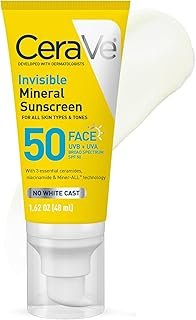
CeraVe Invisible Mineral Sunscreen SPF 50
Verdict: The top mineral sunscreen for sensitive skin SPF 30+ on this list — zinc oxide and titanium dioxide with no chemical filter compromise.
If your skin reacts to chemical UV filters, this is your answer. Zinc oxide and titanium dioxide sit on top of the skin rather than absorbing into it — making this the gentlest option on this list for truly reactive skin. CeraVe adds niacinamide (brightens uneven tone, reduces redness), vitamin E (antioxidant protection), and ceramides (barrier support). The “invisible” claim holds up reasonably well for fair to medium skin tones — deeper skin tones may see a slight cast. At $13.97 for 1.62 oz, it’s a travel size, which makes the per-ounce cost high — but it’s an ideal way to trial a mineral formula before committing to a full size.
Reader tip: “I switched to mineral sunscreen after years of redness from chemical filters. The CeraVe mineral SPF was the first one that didn’t leave me looking gray. I apply it with a damp beauty sponge to blend it in.” — Flourish & Find reader, age 62
| Pros | Cons |
|---|---|
| 100% mineral filters — gentlest for reactive skin | Travel size only (1.62 oz) — high cost/oz |
| Niacinamide + ceramides + vitamin E | May leave slight cast on deeper skin tones |
| Fragrance-free | Smaller review base (871) |
| SPF 50 broad spectrum |
CeraVe AM Facial Moisturizing Lotion SPF 50
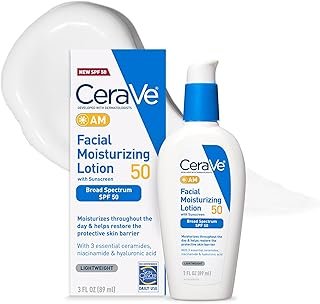
Verdict: Best all-rounder for daily anti-aging sunscreen use — SPF 50, ceramides, niacinamide, and no white cast in a full-size bottle.
This is the hypoallergenic facial sunscreen SPF 30+ option that does the most work in a single step. The full-size 3 oz bottle at $15.87 ($5.29/oz) offers the best value among the CeraVe lineup. Niacinamide addresses hyperpigmentation — a top concern for women 50+ — while ceramides restore the barrier and hyaluronic acid delivers hydration. CeraVe’s MVE technology releases moisturizing ingredients gradually throughout the day. The formula blends seamlessly with no white cast, confirmed across 4,100 reviews at a 4.6/5 rating. Chemical UV filters are used, but the formula is fragrance-free and non-comedogenic.
| Pros | Cons |
|---|---|
| Best value full-size CeraVe SPF on the list | Chemical UV filters |
| Niacinamide targets hyperpigmentation | |
| No white cast — confirmed by 4,100 reviewers | |
| MVE technology for sustained hydration |
Key Ingredients to Look For in Sunscreen for Sensitive Skin
When evaluating any fragrance-free sunscreen for mature skin, scan the ingredient list for these:
Beneficial actives:
- Zinc oxide / titanium dioxide — mineral filters, lowest irritation risk
- Ceramides — replenish the lipid barrier that depletes with age
- Hyaluronic acid — draws moisture into the skin; look for multiple molecular weights
- Niacinamide — reduces redness, brightens dark spots, strengthens barrier
- Centella Asiatica (CICA) — anti-inflammatory, barrier-repairing
Ingredients to avoid on sensitive mature skin:
- Fragrance / parfum — top irritant and sensitizer
- Oxybenzone — chemical filter linked to skin sensitization
- Denatured alcohol (alcohol denat.) — drying and irritating
- Essential oils — natural ≠ gentle; lavender, citrus, and peppermint oils are common irritants
How to Apply Sunscreen Correctly for Maximum Protection
Application errors eliminate much of your SPF protection. Follow this protocol:
- Use the right amount. For the face and neck: approximately 1/4 teaspoon (1.25 ml). Most people apply 20-50% of the required amount, which cuts effective SPF significantly.
- Apply as the last skincare step, before makeup. Sunscreen needs contact with skin — not layered under serums or moisturizers.
- Wait 2 minutes before applying foundation. Allows the formula to set and prevents pilling.
- Reapply every 2 hours during outdoor exposure. A single morning application does not provide all-day protection.
- Don’t skip the neck and ears. These areas show age-related sun damage as clearly as the face.
Common Mistakes When Choosing Sunscreen for Mature Skin
Mistake 1: Choosing SPF based on marketing language alone. “All-day protection” on a label has no regulatory meaning. SPF 30 applied correctly outperforms SPF 100 applied incorrectly.
Mistake 2: Avoiding sunscreen because it feels heavy. Mature skin formulas exist precisely to address this. Every product on this list is lightweight and non-greasy.
Mistake 3: Skipping sunscreen on cloudy days. Up to 80% of UV rays penetrate cloud cover (WHO data). Daily application is non-negotiable.
Mistake 4: Assuming “natural” or “organic” means gentle. Many botanical ingredients are potent sensitizers. Fragrance-free, dermatologist-tested formulas are a more reliable standard than “natural.”
Mistake 5: Not patch-testing a new formula. Apply to your inner arm for 3 days before committing to daily facial use. This is especially important when switching to a new UV filter type.
FAQs About Sunscreen for Sensitive and Aging Skin
Is SPF 30 enough for mature skin? For everyday urban use — commuting, errands, indoor work near windows — SPF 30 is sufficient. For extended outdoor activity, step up to SPF 50.
Is mineral or chemical sunscreen better for sensitive mature skin? Mineral sunscreen (zinc oxide, titanium dioxide) is the gentler choice for truly reactive skin. Chemical filters are well-tolerated by most people and offer lighter textures. If you’ve had reactions to sunscreen before, start with mineral.
Can I use body sunscreen on my face? Not recommended. Body formulas are typically heavier, more likely to contain fragrance, and not formulated for the thinner, more reactive facial skin.
Do I need a separate moisturizer if my sunscreen contains hyaluronic acid? If your skin is very dry, yes. If it’s normal to combination, a moisturizing SPF formula like CeraVe AM or the Neutrogena Ultra Gentle may be sufficient as a single AM step.
Why does sunscreen pill under my makeup? Usually caused by applying too much product or not waiting long enough for it to absorb. Use a 1/4 teaspoon amount and wait 2 minutes before applying foundation.
Final Recommendations and How to Choose Your Perfect Match
The best facial sunscreen for sensitive mature skin SPF 30 depends on your specific skin profile. Here’s the direct guidance:
| Your Skin Profile | Best Pick |
|---|---|
| Budget-conscious, mild sensitivity | Neutrogena Ultra Gentle SPF 30 |
| Want the most-validated formula available | CeraVe Ultra-Light SPF 30 |
| Reactive to oxybenzone specifically | Neutrogena Clear Face SPF 50 |
| Severely reactive — chemical filter intolerant | CeraVe Invisible Mineral SPF 50 |
| Best all-day moisturizer + SPF combo | CeraVe AM Facial Lotion SPF 50 |
If you’re starting from scratch, the CeraVe Ultra-Light SPF 30 is the evidence-backed default — 16,300 reviews at 4.7/5 is a standard of validation that most products never reach. If you know chemical filters are a problem for your skin, go directly to the CeraVe Invisible Mineral SPF 50.
Daily sunscreen use is the single most evidence-supported anti-aging intervention available without a prescription. At under $16, any of these options is a sound investment in skin that stays healthier longer.
Which of these would you try first — or have you already found a favorite in this lineup?